



The textile installation Ckunna tackatur ttasturckota was created collaboratively by the women’s collective Suyis Liq’ cau (1) and Marcela Moraga. The five textiles are intended to embrace, carry and “rematriate” (2) the ancestors of the Lickanantay, whose remains were stolen from Chiu Chiu, a Chilean village in the Antofagasta region of the Atacama Desert. Four of the textiles depict the cycle of the four times of day: sunrise, noon, sundown and night. Their colors are oriented towards the llamas, sheep, plants and soils of the Atacama Desert. They were woven by Suyis Liq’ cau on a traditional comb loom. The warp of this loom is made of alpaca wool from the wetlands of Colchane in the Tarapacá region, while sheep’s wool from the wetlands of Turi in the Antofagasta region was used for the weft (3).
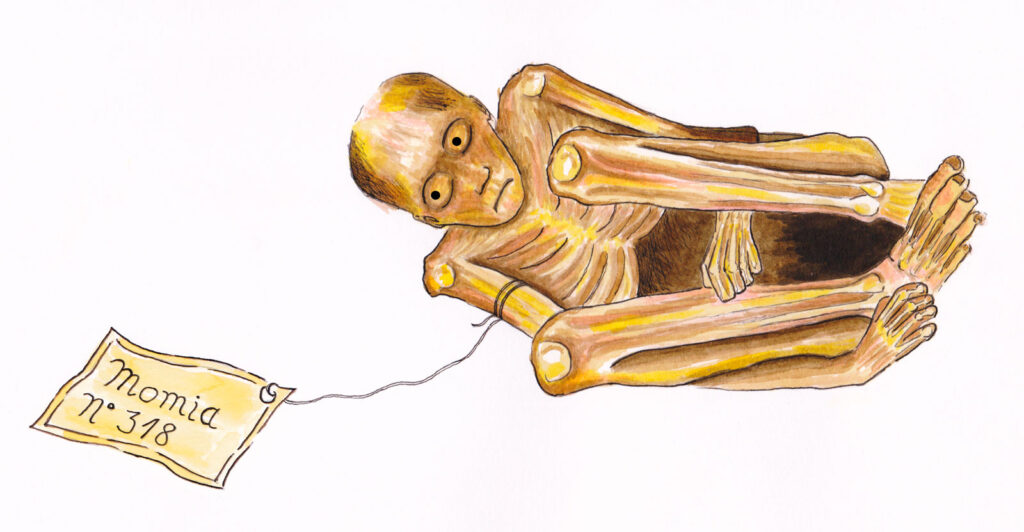
A video animation by Marcela Moraga is projected as a loop onto the central textile. It is based on a series of drawings made by hand with pencil and ink on paper. The images show the burial of a man accompanied by a jar, a woven bag, a corn cob and coca leaves. A weave links all these elements like a constellation. The subsequent drawings document the complete dismemberment of the grave into its individual parts: vessel, bag, corn cob and leaves are transformed into singular museum objects, while the indigenous body is also objectified in a western knowledge system and cataloged as a “mummy”. In further drawings, the hands of the women of the Suyis Liq’ cau collective can be seen weaving and linking together as a symbolic act of repair – as a response to an endlessly repeating process of destruction and as an expression of their persistent demands for restitution. In 1993, the Lickanantay people, also known as the Atacameño, began to demand the return of their ancestors. The series of grave robberies took place between 1850 and 1970, and many Lickanantay grandparents were still displayed unprotected in museum showcases until the beginning of the 21st century. Today, their remains are held in museum repositories and universities in Chile, the United States, Spain and Germany. Most of the offerings and objects placed in the tombs were lost during the plundering; only a few ceramics and textiles remain scattered in various museum collections today.
(1) Suyis Liq’ cau means “women’s hands”, translated from the Ckunsa language. It consists of a group of female weavers, some of whom live in Calama and others in Chiu Chiu. They have been working as a collective since 2012. They weave, knit and crochet dresses, scarves and decorative textiles and sell their creations at various handicraft fairs in Calama, Antofagasta, Caspana, Chiu Chiu and at festivals in the Antofagasta region. (2) “Rematriate” in this work means to bring the ancestors back to Mother Earth, in contrast to the word “repatriate”, which alludes to a patriarchal culture of the state or nation. (3) The wetlands in the Atacama Desert, which include salt plains, swamps and lagoons, are located at an altitude of 3,800 meters and store water all year round, which is why several human communities live near them and practice pastoral farming. They also enable the growth of a variety of plants and are an important habitat for birds, llamas and alpacas.
Ckunna tackatur ttasturckota was commissioned for the group show “Una Tumba de Chiu Chiu” (A tomb of Chiu Chiu) curated by Juan José Santos at Palacio Pereira Museum, Santiago de Chile 2024/25. Together with the artists: David Corvalán, Carolina Alma with the schoolchildren of San Francisco school and Jairo Villalobos.
Textile installation: handwoven textiles made of alpaca wool and sheep. Dimensions: 360 x 360 cm. Animated film loop 2 minutes.
Photos: Claudia del Fierro and Daniela Lopez
Animation assistant: Francisca Villela