
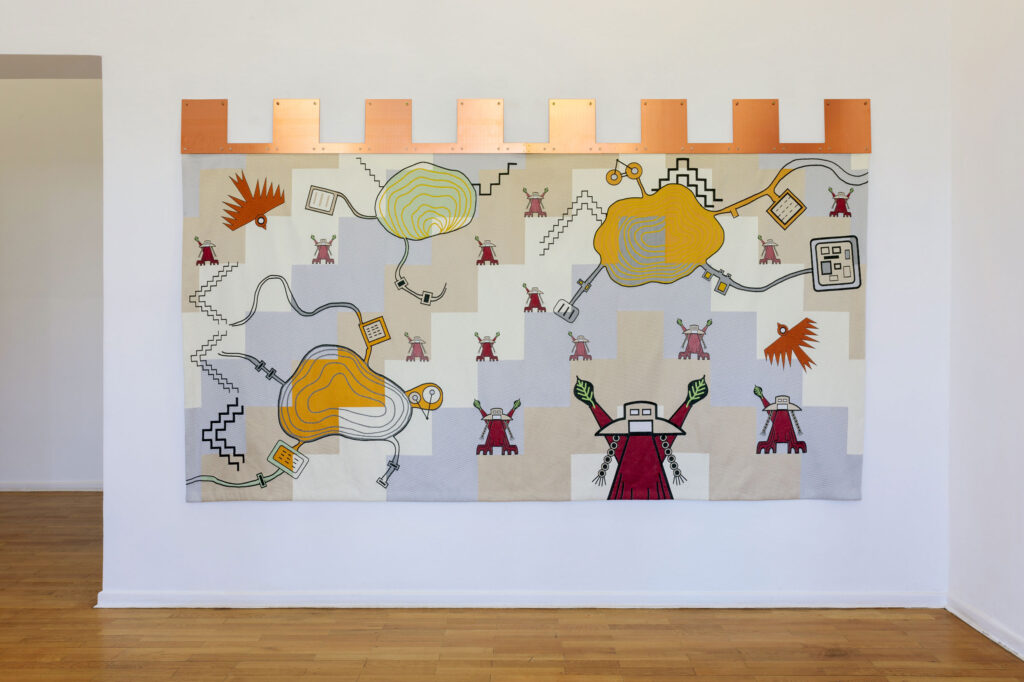


Máxima is a principle in Spanish, it also refers to something big and to the upper limit of what can be achieved. In the Andes lives Máxima Acuña, a farmer and weaver who has won a legal battle against the world’s largest mining company (1). The mine operators are not allowed to extract the gold and copper on her land, however, the woman is constantly threatened by the company’s security forces.
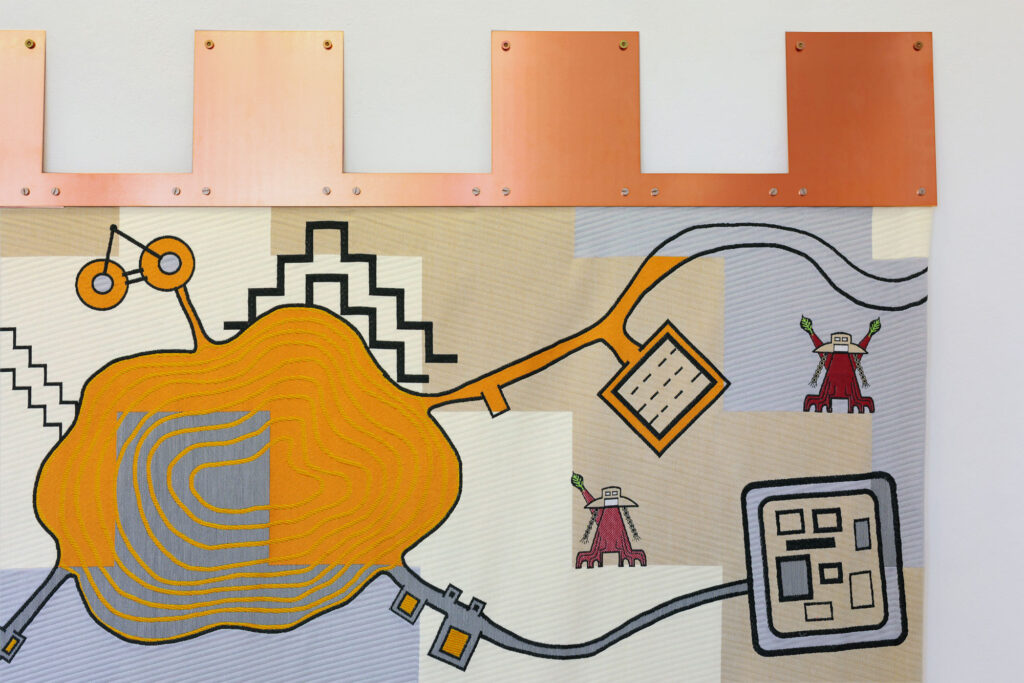
In this new textile document, Marcela Moraga multiplies the figure of a woman with coca hands that appears between illustrations of extractive interventions and reinterpretations of Andean textile designs. It is a confrontation of different forms of production and technologies that come together in the woven image.
The Andean textile is closely interrelated with the mountains. Its complex technology includes not only the tools and knowledge of weaving, but also the interactions between people and their environment. It reflects the dynamic relationships of plural presences in the landscape. For example, the staggered pattern that is repeated in the weavings corresponds to terraced cultivation – an agricultural technology that is integrated into the geography of the mountains and contributes to the diversification of vegetation.
The Andean textile documents this space and the production process with the changes in the living environment as a social and collective instrument of memory.
Modern mining operates primarily under capitalist premises. Its technology forces the mountains to endlessly supply minerals for the global extractive industry. To this goal, huge settlements are being built, both above and below ground. The geography of the mountains is intervened by roads and infrastructure and hollowed out by reservoirs to store water and toxic waste.
Using satellite images of the mining settlements of Yanacocha and Las Bambas in Peru, the artist draws the deep tracks that run through the Andes. These and the other drawings in the composition were converted into vector graphics and then woven on an industrial loom. A copper plate and a series of screws are part of these woven cartographies.
(1) Newmont Mining Corporation
Máxima a Jacquard textile document, 150 x 300 cm. copper sheet and screws.
View of the work in the group exhibition “A Home for Something Unknown” at Haus am Lützowplatz.
Curated by Ines Borchart and Katharina Schilling. Berlin, 2024
Photo: Benjamin Renter
Máxima was funded by Arbeitsstipendien Bildende Kunst 2023. Senate Department for Culture and Social Cohesion Berlin