(Sacred Object)
2023 – 2025
Participating artists:
Litchckane Cka Bautista, Maru Ckamur, Natalia Flores, Sashi Gallardo, Angélica Gamboa, Marcela Moraga, Rodrigo Paredes, Mar Rodríguez, Aldo Salgado, Valeria Valenzuela.
4K and HD Film. 1 Channel Video Installation, Color and Sound.


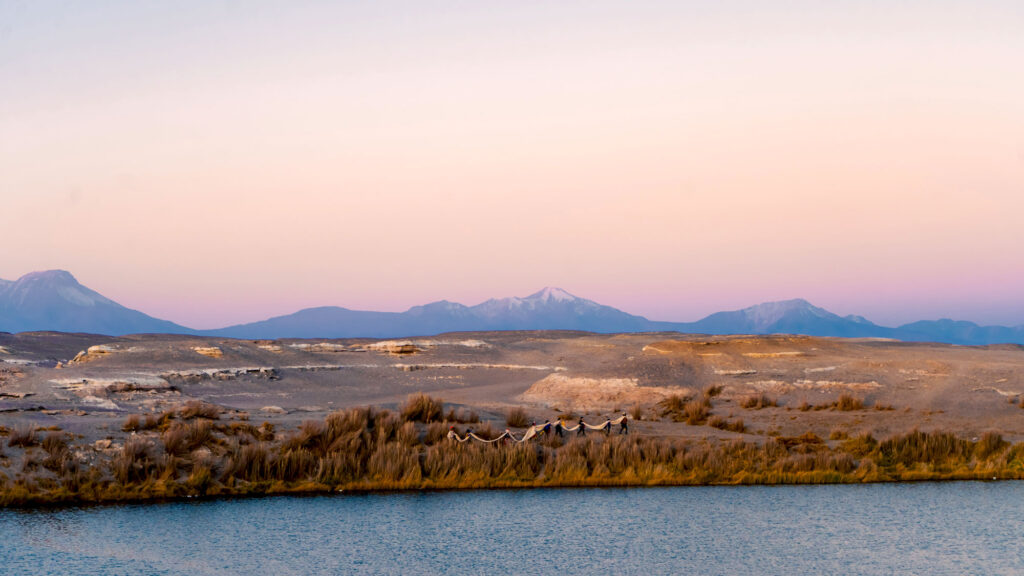


Objeto Sagrado is a collective video performance that was created as part of the workshop Ecosistema Textil, historias de Montañas y Extracciones (Textile Ecosystem, Mountain Stories and Extractions) under the direction of Marcela Moraga. Nine young artists from the mining city of Calama took part in the project. The performance was filmed in the Atacama Desert between the village of Chiu Chiu and Calama in the Antofagasta region of Chile.The performance was filmed in the Atacama Desert between the village of Chiu Chiu and Calama in the Antofagasta region of Chile.
The workshop focused on the textile culture of the Andes. Fabrics were seen as living ecosystems in which socio-cultural, economic and political relationships arise – especially in forms of expression such as clothing, architecture and rituals, including the traditional carnivals of this region. The workshop dealt with archaeological, industrial and mestizo textiles (1) in the context of a region heavily impacted by mining.
Together, the artists visited the textile collection of the Museo de Historia Natural y Cultural del Desierto de Atacama (Museum of Natural and Cultural History of the Atacama Desert), an institution run by a Lickanantay family. The fabrics kept there were excavated in the 1970s at the Topater cemetery, a 2500-year-old burial site. Here, archaeologists found the remains of Lickanantay, Quechua, Aymara and Urus ancestors from the Amazon region – proof that this area has always been a hub of trade and cultural exchange. In addition to the deceased, the archaeologists discovered personal goods such as bags, pipes, corn cobs and ceramics – objects that had accompanied the person’s entire life. The researchers referred to these finds as sacred objects, a term that originated in European archaeology.
In developing their video performance, the artist group decided to define water as their sacred object (2). The images show blue bottles of drinking water, as sold in various cities in Chile. In the vicinity of Calama, there are four large open-pit mines that lead to massive air and water pollution. To avoid illness and poisoning, people should only drink the water from the canisters.
For the creation of the performance outfits, each artist received an industrial awayo (3). A long white fabric was also made available, which was intended to be cut and divided among each performer; however, the artists decided to use the fabric collectively to wear a large poncho and become a mountain range. Additionally, they incorporated their own fabrics, weavings, and ornaments into their clothing.
(1) (3) The artist refers to the industrial Awayos and the variety of fabrics used in this region for making carnival costumes as Mestizo textiles. These fabrics have been integrated into the Andean identity, into the daily and ceremonial life of both the indigenous and non-indigenous populations. Awayo is a type of textile made by the Aymara and Quechua peoples from llama, sheep, and alpaca wool. The industrially manufactured Awayos are woven with yarns, many of which have very bright colors. Both Marcela Moraga and the artists participating in this workshop have used industrial Awayos in their artistic projects. (2) The concept of the object originates from colonial contexts and is critically employed by the artist group. Many objects in ethnological collections were acquired violently or through asymmetric power relations. These objects are not just material things, but often bearers of spiritual, social, or political significance, which have been decontextualized through their uprooting and categorization in Western museums. (see, among others, Azulai, Ariʾelah (2019): Potential history. Unlearning imperialism. London, New York: Verso). In the context of the artistic project, sacred object consciously corresponds to a re-appropriation and is used by the artists in a self-determined way.
About the Performers:
Litchckane Cka Bautista: is a performance artist working with the contrast between Andean indigenous culture and new technologies.. She has participated in several performance projects in the Antofagasta region. She is also studying medicine at Universidad del Alba.
Natalia Flores: is an architect, photographer, curator and director of Al Paso Art Gallery located in Calama. She belongs to the collective Típalo where she develops feminist art works and projects about extractivism.
Sashi Gallardo: works with textile, performance, painting and poetry. She is currently attending a diploma in Performance
Studies at the Universidad Humanismo Cristiano and teaches at a public art high school in the city of Antofagasta.
Angélica Gamboa: is a visual artist and art teacher. She belongs to the graphic arts collective Marraqueta de tres and the feminist art collective Típalo. She teaches visual arts at Radomiro Tomic public high school in Calama.
Rodrigo Paredes: is a graphic designer, painter and muralist. He has carried out projects with environmental groups and neighborhood associations in the city of Calama. He has also participated in several exhibitions and residencies in the Antofagasta Region.
Maru Ckamur: is a self-taught visual artist, muralist and Lickanantay descendant. She develops her work in galleries and public spaces in the Antofagasta Region. She also teaches visual arts in public schools in Calama.
Mar Rodríguez: is an audiovisual artist, art director, costume designer and cultural manager. She has developed and collaborated in short films, video clips, television series and theater. She has produced several cultural events at regional level.
Aldo Salgado: is a self-taught visual artist and sculptor. He has presented his work in galleries and public spaces in the Antofagasta Region. His sculpture El Guerrero de Chug Chug (The Warrior of Chug Chug) based on ancient geoglyphs made by Andean peoples
is installed in El Loa Park in Calama.
Valeria Valenzuela: is a visual and textile artist, designer and graduate in philosophy. She has exhibited her work in several galleries in Chile. She produces the editorial project Diálogos Objetuales. She works as a graphic designer for the Municipality of Calama and for Al Paso Art Gallery.
Cinematography: Nicolás Cid
Editing: Nicolás Cid and Ginés Olivares
Sound design: Eduardo Velázquez and Ginés Olivares
Photos: Nicolás Cid and Natalia Flores
Produced by: H Residency
Support by: Arbeitsstipendien Bildende Kunst 2023, Senate Department for Culture and Social Cohesion Berlin.
Special thanks to the Museo de Historia Natural y Cultural del Desierto de Atacama (Museum of Natural and Cultural History of the Atacama Desert).